

Last updated: November 21, 2026. Data: USDA NASS cash rents (2026 survey year), ISPFMRA and farmdoc daily.
Illinois cash rent per acre for cropland averaged $261 in 2026, down 1.1% from 2025, according to the USDA National Agricultural Statistics Service (NASS). Pasture averaged $53 an acre. Among counties with a 2026 figure, cropland rent ran from $86.50 in Union County at the southern tip of the state to $347 in Macon County in central Illinois.
Highest Illinois farmland rent, 2026
| County | Non-irrigated cropland ($/acre) | Pasture ($/acre) |
|---|---|---|
| Macon | $347 | $37.50 (2019) |
| Moultrie | $337 | $40 |
| Sangamon | $334 | $53.50 |
| Christian | $332 | $65 |
| Logan | $326 | $46 (2025) |
| McLean | $326 | $70.50 |
| Champaign | $316 | $63 (2019) |
| Douglas | $313 | $88.50 |
Lowest Illinois farmland rent, 2026
| County | Non-irrigated cropland ($/acre) | Pasture ($/acre) |
|---|---|---|
| Union | $86.50 | $38 (2022) |
| Williamson | $101 | $25 |
| Lake | $125 | $100 (2020) |
| Franklin | $126 | $69.50 |
Source: USDA NASS county cash rents. Cropland is the 2026 survey year; a year in brackets is NASS’s latest pasture figure for that county. Every county is on the Illinois cash rent by county page.

Why does cash rent vary so much across Illinois?
Central Illinois soils. The top counties sit on the deep, flat prairie soils around Decatur, Springfield and Bloomington, some of the most productive corn and soybean ground anywhere.
Southern Illinois terrain. The lowest-rent counties are mostly in the far south, where land is hillier, soils are less productive, and more acres are in timber and pasture.
Urban edge. Lake County, north of Chicago, is low for a different reason. Farmland near cities is often held for development, comes in small or irregular fields and is leased short-term. Rent reflects what a tenant can earn farming it, not what the land would sell for.
Soil productivity explains most of it. University of Illinois farmdoc daily found that county soil productivity index (PI) and location explain about 82% of the variation in county average rents, with each extra PI point worth about $3.01 an acre (farmdoc daily, 2026). County average PIs run from about 85 in Williamson County to 138 in Piatt County.
What is the cash rent for excellent Illinois farmland?
NASS reports one average per county. The Illinois Society of Professional Farm Managers and Rural Appraisers (ISPFMRA) surveys its members by land quality. Its 2026 mid-year survey, summarized by farmdoc daily, reported:
| Land quality class | 2026 average cash rent ($/acre) |
|---|---|
| Excellent | $384 |
| Good | $325 |
| Average | $277 |
| Fair | $227 |
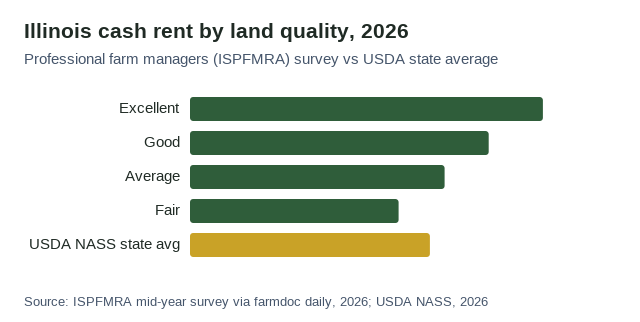
Even the “average” class runs above the NASS state figure. The ISPFMRA survey covers farms run by professional managers and sorts them by soil quality, while NASS averages all rented cropland, so the two measure different things. Use the class that matches your land as a cross-check.
How have Illinois cash rents changed?
Rent moves slowly. Macon County’s $347 in 2026 was down 3.9% from $361 in 2025 but up from $296 in 2019. Rents tend to trail crop income by a year or two because leases are usually set in advance.

Illinois pasture rent
Pasture is a small share of Illinois farmland, and NASS doesn’t publish a pasture figure for every county every year. The 2026 state average was $53 an acre. Among counties with a 2026 pasture figure, Douglas ($88.50), McLean ($70.50) and Franklin ($69.50) were well above it, while Williamson ($25) was about half of it. Fencing, water and forage quality matter a lot, and small tracts are sometimes rented per head or for a flat annual amount.
How Illinois rent compares with land value
Illinois cropland averaged $10,200 an acre in 2026 on our Illinois land values page, up from $7,300 in 2020. The 2026 state rent of $261 is about 2.6% of that, before the landowner’s property tax and other costs. Land prices have risen faster than rents. This is a reading of the averages, not financial advice.
How to set a cash rent for Illinois farmland
- Compare the field to the county. Productivity, drainage, field size and shape, and access matter most. A field’s PI comes from Illinois Bulletin 811 soil ratings.
- Use a revenue formula as a check. University of Illinois Extension’s Determining Cash Rent suggests average yield × price × a factor, with typical arm’s-length factors of 35% to 38% for corn and 40% to 44% for soybeans.
- Look at more than one source. NASS county averages, the ISPFMRA classes above and farmdoc’s PI formula will not match exactly, because they ask different people different questions.
- Choose a lease type. Fixed cash rent puts price and yield risk on the tenant. A flexible lease with a base rent plus a bonus in good years shares it. Crop share is still used on some Illinois farms.
- Check the income. The lease income calculator shows net rent per year, per month and per acre, and your return on land value.
Worked example (illustrative): A landowner in McLean County leases 120 acres at the county average of $326. Gross rent is $39,120 a year. With $4,500 of property tax and insurance, net rent is $34,620, about $289 an acre. If the land is worth the state cropland average of $10,200, the 120 acres are worth about $1,224,000, and the net return is about 2.8%.
Illinois farm lease termination notice
If an Illinois farm lease runs year to year (an oral lease, or a written lease with no end date), it continues unless one side gives written notice at least four months before the end of the lease year. With the common March 1 lease year, that means notice by October 31, according to University of Illinois Extension and farmdoc. A written lease with a fixed end date ends on that date without the four-month notice. Check current law or ask an attorney before changing terms.
About the data
NASS county cash rents come from its annual Cash Rents Survey and cover cropland (irrigated and non-irrigated) and permanent pasture. Not every county has every category every year; our tables show the latest available year where 2026 is missing. You can check any figure in NASS Quick Stats. Survey averages are a starting point, not appraisals, lease quotes, or legal or financial advice.
FAQ
What is the average cash rent per acre in Illinois?
$261 for cropland and $53 for pasture in 2026, according to USDA NASS.
Which Illinois county has the highest cash rent?
Macon County, at $347 an acre in 2026, followed by Moultrie ($337) and Sangamon ($334).
What is the cash rent for excellent farmland in Illinois?
Professional farm managers (ISPFMRA) reported an average of $384 an acre for excellent-quality farmland in 2026, compared with $227 for fair-quality land.
Why is cash rent so low in southern Illinois?
Hillier land, less productive soils and more timber and pasture. Union County averaged $86.50 an acre in 2026.
When must notice be given to end an Illinois farm lease?
For a year-to-year lease, at least four months’ written notice before the lease year ends, which is October 31 for leases ending March 1. A lease with a fixed end date ends on that date.


