Last updated: November 21, 2026. Data: USDA NASS 2026 cash rents; Iowa State University File C2-21 (May 2026).
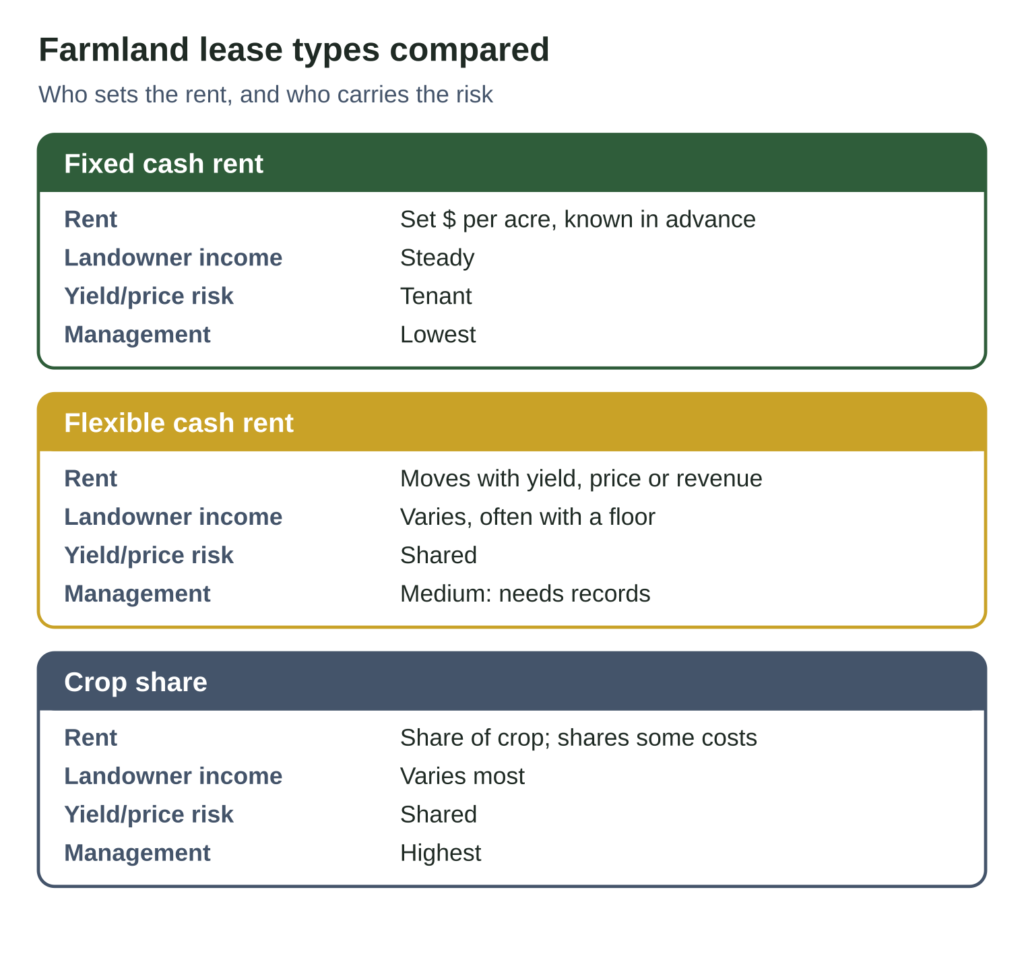
There are three main farmland lease types: fixed cash rent, crop share and flexible cash rent. A fixed cash rent pays the landowner the same amount in good years and bad. A crop share or flexible lease pays more when yields and prices are strong and less when they’re weak. Over several years the totals can come out close; the real difference is who carries the risk.
| Lease type | How rent is set | Landowner’s income | Who carries yield and price risk | 2026 benchmark |
|---|---|---|---|---|
| Fixed cash rent | Set $ per acre | Steady, known in advance | Tenant | Iowa $271, Illinois $261, Nebraska $227 per acre |
| Crop share | Landowner gets a share of the crop and pays a share of some costs | Varies with yield and price | Shared | No single published rate |
| Flexible cash rent | Cash rent that moves with yield, price or revenue | Varies, often within a floor and cap | Shared | ISU examples below |

Which farmland lease type is most common?
Fixed cash rent. USDA’s 2014 Tenure, Ownership and Transition of Agricultural Land (TOTAL) survey found cash rent on 72% of rented farmland in the Midwest, share rent on 19% and flexible cash rent on 8%, as summarized by farmdoc daily. Illinois farm records show the same shift: in central Illinois, the share of leases that were cash rented rose from 21% in 1995 to 53% in 2020.
How does a fixed cash rent lease work?
The tenant pays a set amount per acre, often half in spring and half in fall. The landowner usually pays property tax and sometimes insurance. The tenant pays seed, fertilizer, chemicals, machinery and labour, and keeps the crop.
For the landowner: predictable income and a simple lease. You don’t market grain or track input bills. But you don’t share in a great year, and your rent can lag the local market until it’s renegotiated.
For the tenant: all of the upside and all of the downside. In a poor year, the rent is still due.
What it pays: NASS 2026 state averages for cropland were $271 an acre in Iowa, $261 in Illinois and $227 in Nebraska. County averages vary much more; see the cash rent by county pages.
How does a crop share lease work?
Instead of cash, the landowner receives a share of the harvested crop (or its proceeds) and pays an agreed share of certain inputs such as fertilizer, seed and chemicals. The split is set in the lease and depends on region and on what each side contributes; extension guides often use 50/50 as an example.
For the landowner: income rises and falls with the crop. You decide when to sell your share, pay your share of input bills, and may carry crop insurance. Because you take on risk and costs, crop share can pay more than cash rent over time, and less in bad years.
For the tenant: risk is shared, which helps in a drought or price collapse, but some upside is given up.
Where it’s used: less common than it once was, but still found among family members, long-standing landlord-tenant pairs, and landowners who want to stay involved.
How does a flexible cash rent lease work?
A flexible lease is cash rent that moves with the farm’s results. Iowa State University’s Flexible Farm Lease Agreements (File C2-21, May 2026) describes two common designs.
Share of gross revenue
Rent equals a set share of the crop’s gross revenue per acre. ISU calls this the most common flexible lease type and says rent will typically equal 25% to 40% of gross crop value. ISU’s corn example: 200 bushels at $4.50 is $900, plus $10 of other crop income, for $910. At 30%, rent is $273 an acre.
Base rent plus bonus
The landowner gets a guaranteed base rent plus a share of revenue above a trigger.

At lower prices the bonus shrinks to nothing and rent stays at the $180 base. ISU notes the bonus share may vary from one-third to one-half of revenue above the trigger.
Details to agree in writing: how yield is measured (weigh tickets, yield monitor or county average), which price and on what date, whether crop insurance and government payments count as revenue, and any minimum and maximum rent.
Which lease pays the landowner more?
Compare ISU’s corn example with fixed cash rent. Iowa’s 2026 NASS average cropland rent was $271 an acre. A 30%-of-revenue flex lease paid $273 at 200 bushels and $4.50 corn, almost the same that year. Now change the year (hypothetical yields and prices, other crop income left out):
| Year (hypothetical) | Gross revenue/acre | Fixed cash rent | Flex at 30% of revenue |
|---|---|---|---|
| Strong: 210 bu × $5.00 | $1,050 | $271 | $315 |
| Typical: 200 bu × $4.50 | $900 | $271 | $270 |
| Weak: 170 bu × $4.00 | $680 | $271 | $204 |
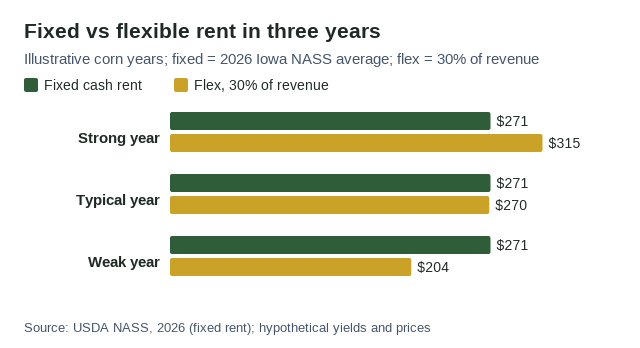
Over several years the totals can come out close. What changes is when the money arrives and who absorbs the bad year. A crop share lease follows a similar pattern, with the landowner also paying part of the input costs.
How to choose a farmland lease type
- Do you need steady income? Retired landowners or those with fixed obligations often prefer fixed cash rent.
- Can you carry a weak year? If so, a flex or crop share lease lets you share in strong years.
- How involved do you want to be? Crop share needs the most management. Flex leases need good records and trust about yields.
- What’s the local norm? Leases that match local practice are easier to negotiate and to replace.
- How strong is the relationship? Shared-risk leases work best with a tenant who shares records readily.
Many landowners settle on a hybrid: a base rent that covers taxes and a reasonable return, plus a bonus in good years.
Run the numbers for your farm
The lease income calculator shows net income per year, per month and per acre, and the return on land value, for any rent. Try your county’s cash rent, then what a flex lease would have paid in a good and a bad year.
This guide is general information, not financial or legal advice. Lease law differs by state, including notice deadlines for ending a year-to-year lease (September 1 in Iowa; four months before the lease year ends in Illinois). Put every lease in writing and consider having an attorney or farm manager review it.
FAQ
What are the main types of farmland leases?
Fixed cash rent, crop share and flexible cash rent. Some leases combine them, such as a base cash rent plus a bonus.
What is the most common farmland lease type?
Fixed cash rent. USDA’s 2014 TOTAL survey found cash rent on 72% of rented farmland in the Midwest, share rent on 19% and flexible cash rent on 8%.
What is a flexible cash rent lease?
A cash lease where rent changes with yield, price or revenue, usually as a share of gross revenue or as a base rent plus a bonus. Iowa State University says most Iowa flex leases set rent at about 25% to 40% of gross crop value.