Last updated: November 22, 2026. Sources: Clemson Cooperative Extension (LGP 1065), University of Nebraska-Lincoln, Iowa State University Center for Agricultural Law and Taxation, University of Illinois Extension and Ohio State University.
A farm lease agreement checklist is the list of terms a landowner and tenant should settle and put in writing before the land changes hands: who the parties are, which land, how long, how much rent and when, who pays for what, how the land is farmed, and how the lease ends. Extension specialists agree on the core list, and they also agree that a written lease drafted or reviewed by an attorney beats a handshake.
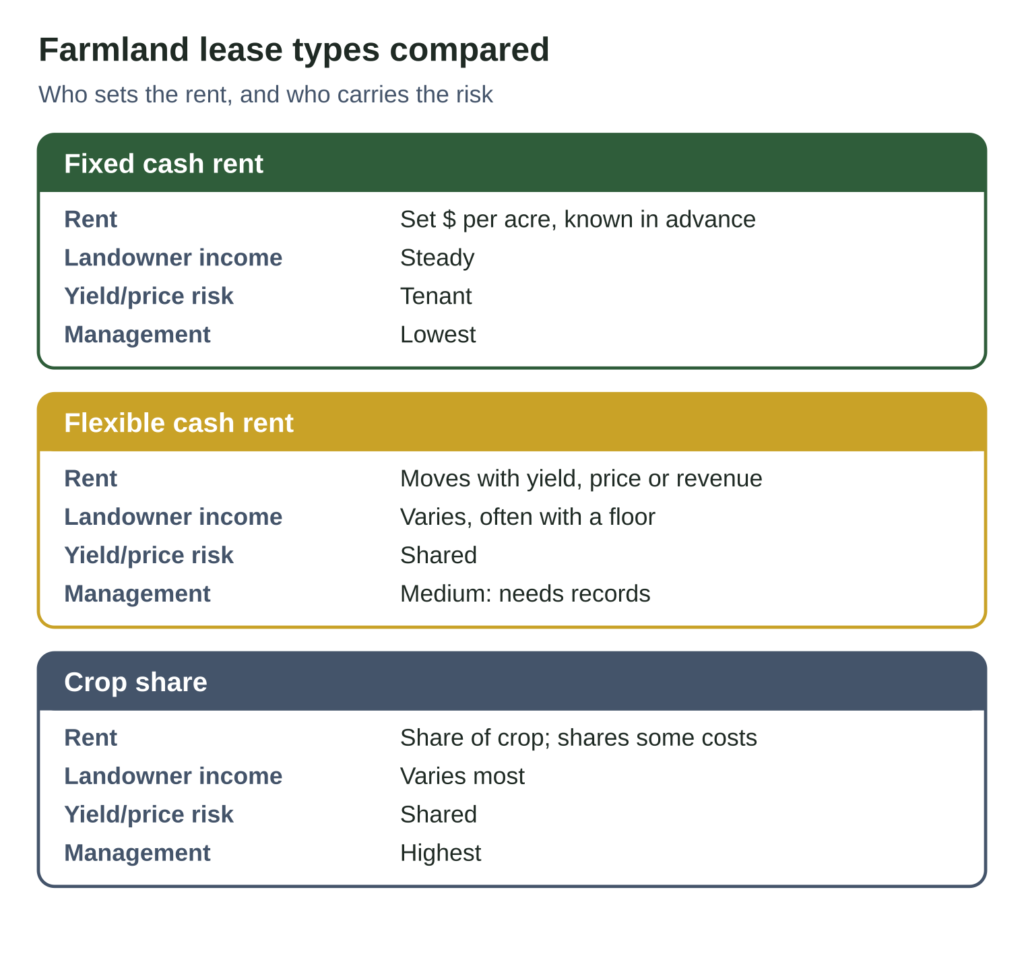
Use the checklist below to prepare for that conversation. It applies to cropland and pasture leases; how you set the rent itself is covered in our guide to cash rent, crop share and flex leases.
Why put a farm lease in writing?
University of Nebraska-Lincoln law specialist J. David Aiken notes that written farm leases are still the exception in Nebraska, often because people worry that asking for one signals distrust. His case for writing it down is practical: a written lease reminds both sides what they agreed, prevents “selective recall,” protects heirs if either party dies, and makes both parties think through each term. Clemson Extension adds that templates are a starting point only, because each lease needs details specific to the farm and to state law.
There is also a legal reason. In several states, if the lease does not say otherwise, state law fills the gap, sometimes in ways neither side expected. Iowa, Illinois and Ohio all have rules about when and how a farm lease can be ended (see below).
The farm lease agreement checklist
1. The basics
- Names of all parties. Clemson advises that all co-owners of the property, including spouses, and all co-owners of the tenant’s business sign.
- A legal description of the land, not just “the north farm.” Attach a map that shows which fields, buildings, lanes and waterways are included or excluded.
- The start date, end date and length of the term.
2. Rent and payment
- The type of lease: fixed cash rent, crop share or flexible cash rent.
- The rate per acre or total, the number of acres it applies to, and how those acres are measured.
- Payment dates, how payment is made, and whether rent is paid in one installment or several.
- For crop share or flex leases: exactly how yields, prices and shared costs are measured and documented.
- What happens if the rent is late.
3. Costs, taxes and insurance
- Who pays real estate taxes. Clemson notes landlords generally do; UNL notes that if the lease is silent, the landlord is responsible for taxes in Nebraska.
- Who insures buildings and improvements, and confirmation that both parties carry liability insurance.
- How other expenses are divided, such as maintenance, chemicals, repairs and utilities. UNL advises spelling out each party’s share.
4. Repairs and improvements
- Which repairs belong to the tenant (usually minor upkeep, such as a broken fence post) and which belong to the owner (major repairs such as a barn roof).
- Whether the tenant needs permission before making improvements.
- How the tenant is repaid if the lease ends before a tenant-paid improvement has been used up. Clemson’s example: match the lease term to the useful life of the improvement and refund the unused share if the landlord ends the lease early.
- What the tenant may remove at the end of the lease. UNL points out that courts can treat items such as fences and windmills as fixtures that stay with the land unless the lease says otherwise.
5. How the land is farmed
- Any limits on crops, rotations, tillage, hay reseeding, conservation practices, chemical use or manure.
- Duty to control noxious weeds and maintain drainage ditches and waterways.
- That the land is returned in the same condition, apart from normal wear.
- Who owns or may use GPS yield maps and other field data. University of Illinois Extension notes that older lease templates never addressed these.
6. Government programs
- Which party signs up for USDA Farm Service Agency and NRCS programs, how payments are split, and which documents each side provides.
7. Access and use
- The landlord’s right to enter the property, and any notice required before visits.
- Whether the tenant may sublease or assign the lease. UNL notes that if the lease is silent, Nebraska courts presume the tenant can, so say so either way.
- Hunting, recreation, timber and mineral rights: who keeps them, and whether the tenant may lease hunting rights to others.
8. Ending the lease
- How and by when either party must give notice not to renew.
- Early termination: when it is allowed, and how the tenant is paid for crops planted, fall fieldwork done or inputs applied but not yet used.
- What happens if the farm is sold or a party dies: is the lease binding on heirs and new owners?
- Any right of first refusal or option for the tenant to buy.
9. Protection clauses
- A statement that the lease does not create a partnership.
- A hold-harmless clause so the landlord is not liable for the tenant’s business activities.
- A dispute-resolution step, such as mediation, before going to court.
- Signatures and dates from everyone who needs to sign.
Termination rules differ by state
The most expensive mistake in farm leasing is often a missed notice deadline. Three examples from university law and Extension specialists show how much the rules vary:
- Iowa. A farm tenancy automatically continues for another crop year on the same terms unless written notice is served before September 1, which then ends the lease the following March 1. This applies to written and oral leases and to multi-year leases. The Iowa State University Center for Agricultural Law and Taxation stresses that courts apply the notice rules strictly; for example, a notice sent by regular instead of certified mail can fail.
- Illinois. Year-to-year leases with no set term, including oral leases, need four months’ written notice, and with the traditional March 1 lease year that has meant notice by about October 31. A written lease with a specific end date does not need that notice.
- Ohio. A landlord must give written notice to end a verbal farmland lease by September 1, unless the lease provides otherwise.
Other states have their own rules. Check your state’s law with your Extension office or an attorney, and put the notice terms you want in the lease itself.
Common mistakes
- Relying on an oral lease, or a lease that has simply rolled over for years.
- Downloading a generic template and not adapting it to the farm or the state.
- Leaving out how acres, yields or prices are measured in a flex or share lease.
- Saying nothing about improvements, then arguing over who owns a new well, tile line or fence.
- Missing the statutory notice deadline, which can lock both sides into another year.
When to get a pro
Have an attorney who knows agricultural law draft or review any written lease, and always for long-term leases, leases with tenant-paid improvements, or leases on land owned by several heirs. A professional farm manager can help set rent and monitor the lease if you live far from the farm.
FAQ
What should be included in a farm lease agreement?
At minimum: the parties, a legal description of the land, the term, the rent and payment dates, who pays which costs, repairs and improvements, how the land is farmed, government program payments, access, and how and when the lease ends.
Is a verbal farm lease legal?
Oral leases are used in many states, but they are risky: they are hard to prove, and state law decides the terms you did not spell out, including notice deadlines.
How much notice is needed to end a farm lease?
It depends on the state and the lease. Iowa generally requires notice before September 1; Illinois year-to-year leases need four months’ notice; Ohio verbal leases need landlord notice by September 1.
Should a tenant pay the property taxes?
Usually the landlord pays. If a tenant pays on the landlord’s behalf, Clemson Extension advises treating it as part of the rent for accounting and tax purposes.
Related guides
- Cash Rent vs Crop Share vs Flex Lease: Farmland Lease Types Compared
- How to Determine Cash Rent per Acre: A Fair Rent in 4 Checks
- Hunting Lease Prices per Acre by Region
Sources and further reading
- Clemson Cooperative Extension, Farm Rental Agreement Checklist (LGP 1065)
- University of Nebraska-Lincoln, Written Farmland Lease Checklist
- Iowa State University CALT, Iowa Farm Lease Termination Deadline
- University of Illinois Extension, Terminating a Farm Lease in Illinois
- University of Illinois Extension Farm Coach, Farmland Owner Series: Terminating a Farm Lease
- Ohio State University Farm Office, statutory termination of farm leases
This checklist is general information, not legal advice. Lease law differs by state.