

Last updated: November 21, 2026. Data: USDA NASS 2026; Iowa State University and University of Illinois Extension.
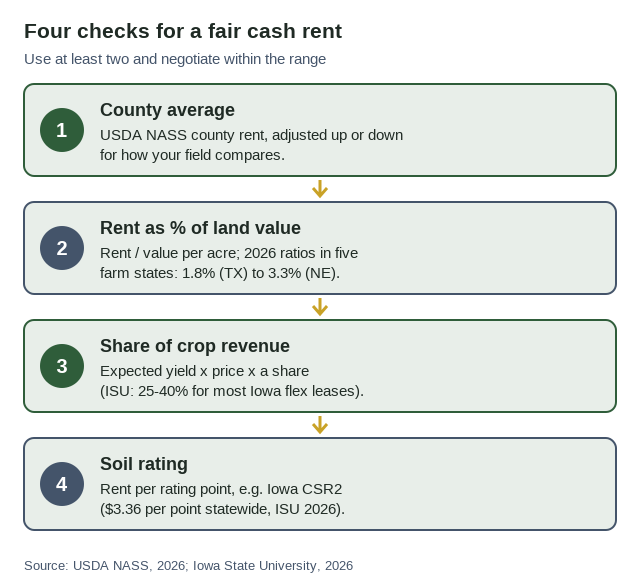
To determine cash rent per acre, start with your county’s average rent, then test it three ways: as a percent of land value, as a share of expected crop revenue (yield × price × a share, often 30% to 40%), and, where available, by soil rating. Where the checks overlap is a fair range to negotiate within.
Here’s how the first two checks look for four real counties, using 2026 data from the USDA National Agricultural Statistics Service (NASS):
| County | 2026 county cropland rent | State cropland value | Rent as % of value |
|---|---|---|---|
| Macon, Illinois | $347 | $10,200 (Illinois) | 3.4% |
| Sioux, Iowa | $336 | $10,700 (Iowa) | 3.1% |
| Wharton, Texas | $63 | $2,790 (Texas) | 2.3% |
| Sampson, North Carolina | $120 | $5,580 (North Carolina) | 2.2% |
County rents are non-irrigated cropland. Land values are statewide because NASS doesn’t publish land values by county, so the percentages are rough.

Method 1: Start with the county average
The county NASS average is the best quick read on the local market. Find your county on the cash rent by county page; each county page has history, so you can see whether rents are rising or falling. University of Illinois Extension cautions that the USDA county survey average tends to run low, so treat it as a floor for good ground rather than a ceiling.
Then ask whether your field is better or worse than typical ground in the county:
- Better: productive, well-drained soils; large, square fields; good road access; tile installed; close to grain markets.
- Worse: small or odd-shaped fields, wet spots, steep slopes, poor access, tree lines, weed or drainage problems.
Method 2: Rent as a percent of land value
Divide annual rent by land value per acre.
Example: Sampson County, North Carolina, averaged $120 an acre of cropland rent in 2026. North Carolina cropland averaged $5,580 on our North Carolina land values page. $120 ÷ $5,580 = 2.2%.
To turn it around, multiply your land’s market value by the ratio typical in your area. Land worth $10,000 an acre where rent runs about 2.5% of value suggests about $250.
Use it carefully. Land values have risen faster than rents: Iowa farm real estate went from $7,420 an acre in 2021 to $10,100 in 2026 on our Iowa land values page. A rent set as a fixed percent of today’s value can exceed what a tenant can earn from the crop, so check it against Method 3. Rent-to-value describes what the market pays; it is not a target return or financial advice.
Method 3: Share of expected crop revenue (the cash rent formula)
Cash rent = expected yield × expected price × share
University of Illinois Extension’s Determining Cash Rent gives typical arm’s-length factors of 35% to 38% for corn and 40% to 44% for soybeans, lower between relatives. Its corn example: 200 bushels × $5 × 36% = $360 an acre. Iowa State University’s Flexible Farm Lease Agreements says most Iowa flexible leases set rent at roughly 25% to 40% of gross crop value; its example is 30% of $910 = $273.
- Use a realistic yield for the field, such as its own five-year average or the county average.
- Use a realistic harvest price, such as a local new-crop bid or the crop insurance projected price.
- Multiply for gross revenue per acre, then apply a share typical for your area.
You can use this to set a fixed rent or as the basis of a flexible lease recalculated each year.
Method 4: Soil ratings (where available)
Some states rate soil productivity, and rent surveys report rent per rating point.
- Iowa: Iowa State University’s Cash Rental Rates for Iowa 2026 Survey put the statewide average at $3.36 per Corn Suitability Rating (CSR2) point. A field averaging CSR2 85 works out to about $286 an acre.
- Illinois: farmdoc daily’s 2026 analysis estimates county average rent as −136 + 3.01 × productivity index (PI) plus a district adjustment, so each PI point is worth about $3.01 (farmdoc daily). It notes individual farms can differ from the formula by $100 an acre or more.
Putting it together: a worked example
A landowner in Macon County, Illinois, has 80 acres of good, well-drained cropland and wants to set rent for next year.
- County average: $347 an acre in 2026, down 3.9% from $361 in 2025.
- Field quality: slightly better than average, with two small wet spots.
- Revenue check: a hypothetical 220-bushel corn yield at $4.40 is $968 of gross revenue; 30% is about $290 and 35% about $339.
- Value check: if comparable land sells for about $12,000 an acre, $336 of rent would be 2.8% of value.

The landowner and tenant might settle near the county average, or agree on a lower base with a bonus in strong years. The lease income calculator shows what any rent means in net income per year, per month and per acre after property tax and insurance, and the land value calculator gives a quick benchmark for the land value input.
What else affects a fair cash rent?
- Who pays what. Property tax, insurance, lime, tile repairs, conservation practices and waterway upkeep.
- Lease length. Multi-year leases give the tenant reason to invest in fertility; annual reviews let rent follow the market.
- Payment timing. Half in spring and half in fall is common.
- Conservation and care. Expectations for tillage, cover crops, soil testing and fertility.
- Termination notice. State law sets deadlines for ending year-to-year leases, such as September 1 in Iowa and four months before the lease year ends in Illinois.
A fair rent is one both sides can live with for the length of the lease. A careful long-term tenant is worth something, and so is a landowner who invests in the land.
This guide is general information based on public survey data. It isn’t an appraisal, a lease recommendation, or financial or legal advice. Put leases in writing and consider professional review.
FAQ
What is the formula for cash rent per acre?
A common approach is expected yield × expected price × a share. University of Illinois Extension uses 35% to 38% for corn and 40% to 44% for soybeans; ISU reports 25% to 40% for most Iowa flexible leases. Compare the result with the county average and with land value.
What percentage of land value should cash rent be?
There’s no set percentage. In 2026 NASS data, statewide cropland rent was about 2.5% of cropland value in Iowa, 2.6% in Illinois, 3.3% in Nebraska, and under 2% in North Carolina and Texas.
How much should I charge to rent my farmland?
Start at your county’s average rent, adjust for how your field compares, and check it against a revenue-based estimate. Most landowners settle within the range those checks give.
Is the USDA county average rent too low?
It can be. University of Illinois Extension says USDA county averages tend to run low, especially compared with rents on good farmland. Use it as a starting point, not a ceiling.
Where do I find my county’s average cash rent?
On our county pages, which republish USDA NASS county cash rents, or in NASS Quick Stats.


