

Last updated: November 21, 2026. Data: USDA NASS cash rents and land values, 2026.
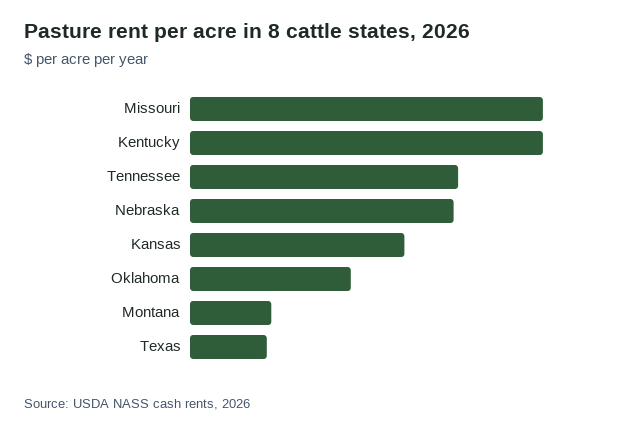
Pasture rent per acre ranged from $68.50 in Iowa to $2.80 in Arizona in 2026, according to USDA National Agricultural Statistics Service (NASS) survey data. In major cattle states it mostly ran $18 to $40 an acre, while Texas averaged $8.60. The difference comes down mostly to rainfall and how much grass an acre grows, which is why western grazing is often priced per animal unit month (AUM) instead.
| State | Pasture rent ($/acre/yr) | Pasture value ($/acre) | Rent as % of value |
|---|---|---|---|
| Missouri | $39.50 | $2,850 | 1.4% |
| Kentucky | $39.50 | $4,050 | 1.0% |
| Tennessee | $30 | $5,910 | 0.5% |
| Nebraska | $29.50 | $1,590 | 1.9% |
| Kansas | $24 | $2,400 | 1.0% |
| Oklahoma | $18 | $2,200 | 0.8% |
| Montana | $9.10 | $940 | 1.0% |
| Texas | $8.60 | $2,420 | 0.4% |
Source: USDA NASS, 2026 survey year: pasture cash rents and pasture land values. Rent-to-value is our calculation.
Every state’s pasture rate is on the cash rent by state page, and most states have county pages too.
Which states have the highest and lowest grazing lease rates?
Highest (2026): Iowa ($68.50), Maryland ($62.50), Indiana ($61), Illinois ($53), Pennsylvania ($48.50) and Wisconsin ($44.50). These are humid states where pasture grows a lot of forage and often competes with cropland for the same ground.
Lowest (2026): Arizona ($2.80), New Mexico ($4.20), Wyoming ($7.30), Colorado ($7.60), Utah ($8.20), Washington ($8.30), Texas ($8.60) and Montana ($9.10). Much of the pasture in these states is arid rangeland where many acres are needed to carry one cow.
What is an AUM, and why is western pasture priced that way?
An animal unit month (AUM) is the forage one animal unit eats in a month. Iowa State University defines it as one beef cow, or its equivalent, grazing for one month, and Oregon State University Extension describes one animal unit as a 1,000-pound cow (OSU).
On dry range an acre might feed a cow for only a few days a year, so per-acre rent says little about value. A $9.10 average in Montana and $68.50 in Iowa can represent similar value per pound of grass. That’s why western leases are usually priced per AUM or per head per month.
To price a lease that way, estimate carrying capacity (AUMs per acre or acres per cow) with help from your local NRCS office or extension service, then apply a local rate. Some 2026 reference points:
- Iowa: $27 per AUM, $102 an acre for high-productivity pasture and $63 for low-productivity pasture (ISU Cash Rental Rates 2026).
- Nebraska: $56.45 to $82.10 per cow-calf pair per month by district, highest in the Sandhills-dominated north (UNL CropWatch).
County pasture rents: examples
| County | 2026 pasture rent ($/acre) |
|---|---|
| Pottawattamie, Iowa | $91 |
| Plymouth, Iowa | $90.50 |
| Chase, Kansas | $36 |
| Wharton, Texas | $30.50 |
| Greenwood, Kansas | $26 |
| Cherry, Nebraska | $17.50 |
Source: USDA NASS county cash rents, 2026 survey year.

Chase and Greenwood counties lie in the Kansas Flint Hills tallgrass region (Chase County is home to the Tallgrass Prairie National Preserve), and both rent above the Kansas pasture average of $24. Cherry County, in the Nebraska Sandhills, has vast grazing land but rents below the state average of $29.50 per acre, a reminder that per-acre figures understate range value. Wharton County, on the Texas coastal plain, rents at more than three times the Texas average.
Why is pasture rent so low compared with land value?
In every state in our table, pasture rent was under 2% of pasture value in 2026, and in Texas and Tennessee it was about half a percent or less.

Pasture prices reflect more than grazing: hunting and recreation, homesites, timber, minerals and long-term appreciation. Grazing rent reflects only what a cattle operation can afford to pay for grass. That matters if you’re buying pasture expecting rent to cover the cost. This is a reading of the averages, not financial advice.
What affects the pasture rent you can charge?
- Forage quality and quantity. Improved, fertilized pasture rents for more than native or overgrown pasture.
- Water. Reliable ponds, streams, wells or rural water are essential.
- Fencing and handling facilities. Good perimeter fence, cross-fencing for rotation and working pens add value. The lease should say who maintains fence.
- Who does what. Rent is higher if the landowner provides fertilizer, weed control or checks cattle; lower if the tenant does all of it.
- Season length. A summer-only lease rents for less than a year-round one.
- Stocking rate. The lease should cap head or AUMs so the pasture isn’t overgrazed.
How to price a cattle pasture rent: worked example
A landowner in Missouri has 120 acres of fenced pasture with ponds. The 2026 Missouri pasture average was $39.50 an acre.
- Per-acre check: 120 × $39.50 = $4,740 a year at the state average.
- Adjust: the pasture is improved fescue with good water and new perimeter fence, so the landowner aims somewhat above average.
- Per-head check (illustrative): if the pasture carries 30 cow-calf pairs for a 6-month season, $4,740 works out to about $26 per pair per month. Compare with local per-head rates.
- Net income: the lease income calculator subtracts property tax, insurance and fence costs and shows net income and return on land value. At the state pasture value of $2,850, the 120 acres are worth about $342,000, so $4,740 of gross rent is about 1.4% before costs.
About the data
NASS publishes pasture cash rents by state and, where enough reports come in, by county; check figures in NASS Quick Stats. Land values come from NASS’s Land Values 2026 Summary, released July 31, 2026. These are survey averages, not appraisals or rent quotes, and this isn’t financial or legal advice. Put grazing leases in writing, including stocking limits, fence and water duties, and liability.
FAQ
What is the average pasture rent per acre?
It ranges widely. In 2026 NASS data, state averages ran from $2.80 an acre in Arizona to $68.50 in Iowa. Most of the eight cattle states in our table were between $18 and $40.
How much does pasture rent for in Texas?
$8.60 an acre on average in 2026, according to NASS. Wetter counties rent higher, such as Wharton County at $30.50.
What is a fair price per AUM for grazing?
It depends on the region and forage. Iowa State University’s 2026 survey reported $27 per AUM for Iowa pasture, where one AUM is one beef cow or its equivalent grazing for a month.
Should I charge pasture rent per acre or per head?
Either can work. Per-acre is simpler; per-head or per-AUM ties rent to how many animals the land carries, which is common on western range.
How many acres does a cow need on pasture?
It varies from under an acre to dozens of acres depending on rainfall and forage. ISU classes Iowa pasture as high-productivity if it can stock a cow on 2.5 acres or fewer. Your NRCS office can estimate carrying capacity.


