Last updated: November 21, 2026
There is no single number for timber value per acre. Two tracts side by side can differ by thousands of dollars an acre because one holds big pine sawlogs and the other holds young pulpwood. What you can do is work it out the way a forester does: how much wood is standing, what products it would make, and what buyers are paying for each product near you. This guide walks through that math with 2026 prices from state extension reports and shows where our free timber sale value calculator fits in.
The short answer: volume times stumpage price, product by product
Timber is sold “on the stump,” meaning the buyer pays for standing trees and covers the cost of cutting and hauling. That price is called stumpage. Each product class has its own price, so the value of an acre is:
(tons or board feet of each product per acre) x (stumpage price for that product), added up, minus any forester’s fee.
Here are statewide average stumpage prices from three Southern state reports. They show how wide the gap between products is.
| Product (stumpage, $ per ton) | North Carolina, Q3 2026 | Mississippi, Q2 2026 | Texas, Nov/Dec 2025 |
|---|---|---|---|
| Pine sawtimber | $28.61 | $22.03 | $28.63 |
| Pine chip-n-saw | $19.73 | $12.52 | $14.66 |
| Pine pulpwood | $7.36 | $4.77 | $6.01 |
| Mixed hardwood sawtimber | $28.10 | $39.81 | $37.87 |
| Hardwood pulpwood | $4.56 | $9.02 | $6.93 |
Sources: NC State Extension, North Carolina Standing Timber Price Report 2026 (Timber Mart-South data); Mississippi State University Extension, Mississippi Timber Price Report, 2nd Quarter 2026 (Timber Mart-South data); Texas A&M Forest Service, Texas Timber Price Trends, November/December 2025. The NC State page heads its third-quarter table “2nd Quarter 2026”, apparently a carried-over label; the figures used here are the ones under its “3rd Quarter 2026” heading, which differ from the Q2 table.
Pine sawtimber in North Carolina was worth almost four times as much per ton as pine pulpwood in the third quarter of 2026 ($28.61 against $7.36). That ratio is the whole story of timber value: a stand’s worth depends mostly on how much of it is large, straight sawlog material.

Every one of these reports warns that averages are a guide, not a price for your stand. Mississippi State’s report says the average “should not be applied as fair market value for a specific timber sale,” because species, tree size and quality, access, local mills and logging capacity all move the price.
A worked example (illustrative volumes)
Suppose a forester cruises a 40-acre pine stand in North Carolina and finds, per acre, 30 tons of pine sawtimber, 15 tons of chip-n-saw and 20 tons of pulpwood. These volumes are made up for the example; your cruise will give your own. Using the Q3 2026 NC statewide averages:
| Product | Tons per acre | Price per ton | Value per acre |
|---|---|---|---|
| Pine sawtimber | 30 | $28.61 | $858.30 |
| Chip-n-saw | 15 | $19.73 | $295.95 |
| Pine pulpwood | 20 | $7.36 | $147.20 |
| Total | 65 | $1,301.45 |
Across 40 acres that is $52,058 gross. If a consulting forester charges 10% to mark, advertise and supervise the sale, the fee is about $5,206 and the landowner nets about $46,852, or roughly $1,171 an acre. Fee levels vary; ask the forester what theirs is.
Change one assumption and the answer moves a lot. If the same 65 tons were all pulpwood, the stand would be worth about $478 an acre (65 x $7.36). That is why timber age and management matter so much.

You can run this exact calculation, with your own products and prices, in the timber sale value calculator. It has rows for pine sawtimber, hardwood sawtimber, chip-n-saw, pine pulpwood and hardwood pulpwood, takes quantities in tons or thousand board feet (MBF), and subtracts a forester’s fee percentage to show what you net.
Step by step: estimating what your timber is worth
1. Get a timber cruise
A cruise is a sample-based inventory: a forester measures trees on plots across the tract and expands the results to the whole property. It tells you species, diameter classes, product volumes and quality. Without it, any per-acre value is a guess. Many state forestry agencies can point you to consulting foresters, and some do free or low-cost management visits.
2. Split the volume into products
Mills pay by product. In the South, pine is commonly split into sawtimber (largest logs, for lumber), chip-n-saw (mid-size logs that yield some lumber and chips) and pulpwood (small or poor-quality stems for paper and fiber). Hardwood is commonly split into sawtimber and pulpwood, and some reports break out oak sawtimber separately. Mississippi’s Q2 2026 report put oak sawtimber at $57.35 a ton against $39.81 for mixed hardwood sawtimber.
3. Match the unit to the price
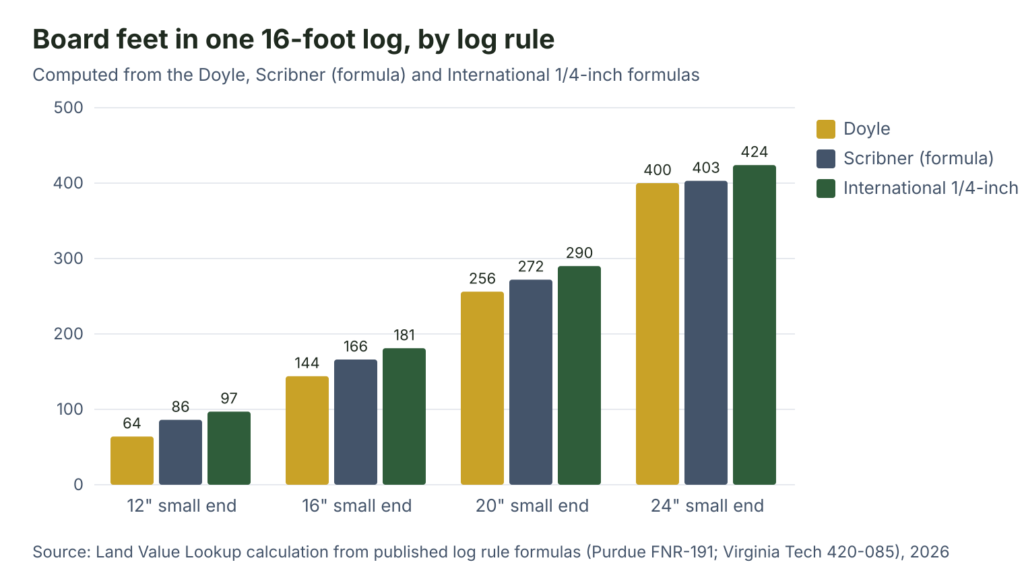
Southern pine is usually priced by the ton. Hardwood sawtimber, especially in Appalachia and the North, is usually priced per thousand board feet. If your cruise is in board feet, you can estimate log volume with the board foot calculator, which supports the Doyle, Scribner and International 1/4-inch log rules. Use the rule your buyer uses; they give different answers for the same log. Doyle is widely used on private timber in the South and East, according to Virginia Tech and Purdue Extension. NC State’s report lists conversion factors, such as about 7.0 tons per thousand board feet (Scribner) for pine sawtimber and 9.0 tons per MBF (Doyle) for hardwood sawtimber.
4. Use local, current prices
Statewide averages are a start. Regional prices within a state can differ (Texas reported pine sawtimber at $28.82 a ton in Northeast Texas and $27.27 in Southeast Texas for November/December 2025), and prices change every quarter. North Carolina pine pulpwood moved from $8.33 in Q1 2026 to $7.02 in Q2 and $7.36 in Q3. The best local price is the one competing buyers bid on your timber in a sealed-bid sale.
5. Subtract costs and think about timing
Fees, road work, and the value of leaving trees to grow all matter. Young sawtimber that will grow into a higher-value class may be worth more left standing. A forester can tell you how much growth to expect.
Timber value vs land value
Timber is usually a separate asset from the land under it, and survey land values do not isolate it. USDA’s National Agricultural Statistics Service publishes farm real estate, cropland and pasture values by state; it does not publish a timberland value. For context in the main timber states, here are the 2026 USDA NASS farm real estate averages (land and buildings) from our state pages:
| State | Farm real estate, 2026 ($/acre) | Change from 2025 |
|---|---|---|
| Georgia | $4,950 | +4.9% |
| Alabama | $4,250 | +2.4% |
| Mississippi | $3,650 | +2.0% |
| North Carolina | $5,750 | +5.1% |
| West Virginia | $3,640 | +3.4% |
Source: USDA NASS, Land Values 2026 Summary, via each state page. These are survey averages across a whole state for farmland, not appraisals and not timberland prices. A wooded tract with merchantable timber may sell above or below these figures depending on the timber, access, location and recreation value. For a rough land-only figure, the land value calculator multiplies your acres by a state average or by your own per-acre number.
Taxes on a timber sale
Timber sale income is taxed, and how depends on how long you have held the timber, whether you sell lump-sum or pay-as-cut, and whether you can claim a basis (depletion) deduction. The USDA-supported National Timber Tax website publishes yearly tax tips for forest landowners. Talk to a tax professional before the sale closes, not after.
Common mistakes landowners make
- Accepting the first offer. A single buyer knocking on the door sets the price on his terms. Competitive bids, usually organized by a consulting forester, give buyers a reason to pay full value.
- Using pulpwood prices for sawtimber, or the reverse. The product mix is the biggest driver of per-acre value.
- Ignoring the log rule. A Doyle board-foot figure and an International 1/4-inch figure for the same stand are not the same number. Penn State’s timber market report notes a Doyle price is about 1.695 times an International 1/4-inch price for the same timber.
- Treating averages as appraisals. Extension reports summarize reported sales. Your timber can bring more or less.
FAQ
How much is an acre of timber worth? It depends on the volume and product mix. Using NC State’s Q3 2026 statewide averages, an acre carrying 30 tons of pine sawtimber is worth about $858 in sawtimber alone, while an acre of young pulpwood may be worth a few hundred dollars. Get a cruise to know your own volume.
Are timber prices the same across my state? No. Reports show regional differences within a state, and prices for a particular stand depend on access, tract size, quality and local mills.
Where do I find current stumpage prices? Many state extension services and forestry agencies publish quarterly or bimonthly reports, including NC State Extension, Mississippi State Extension and the Texas A&M Forest Service. Penn State Extension publishes hardwood prices per thousand board feet.
How long does it take for timber to become valuable? It depends on species, site and management. Pine planted for sawtimber is commonly grown for decades before a final harvest, with thinnings sold as pulpwood or chip-n-saw along the way. A forester can estimate when your stand will move into higher-value product classes.
Is timber taxed when I sell it? Usually yes. Holding period, sale type and your basis all matter. See the National Timber Tax website and ask a tax professional.
This guide is general information, not an appraisal or financial advice. Talk to a consulting forester before you sell timber.