
Last updated: November 21, 2026
If you want to know how to calculate board feet in a log, the first thing to learn is that there is no single answer. A log rule is a formula or table that estimates how much lumber a sawmill can cut from a log, and the three rules used in the United States (Doyle, Scribner and International 1/4-inch) give different results for the same log. When you sell timber, the rule in the contract can change the board-foot count by a quarter or more. Here is how each rule works, a chart you can check against, and how to run the numbers in our free board foot calculator.
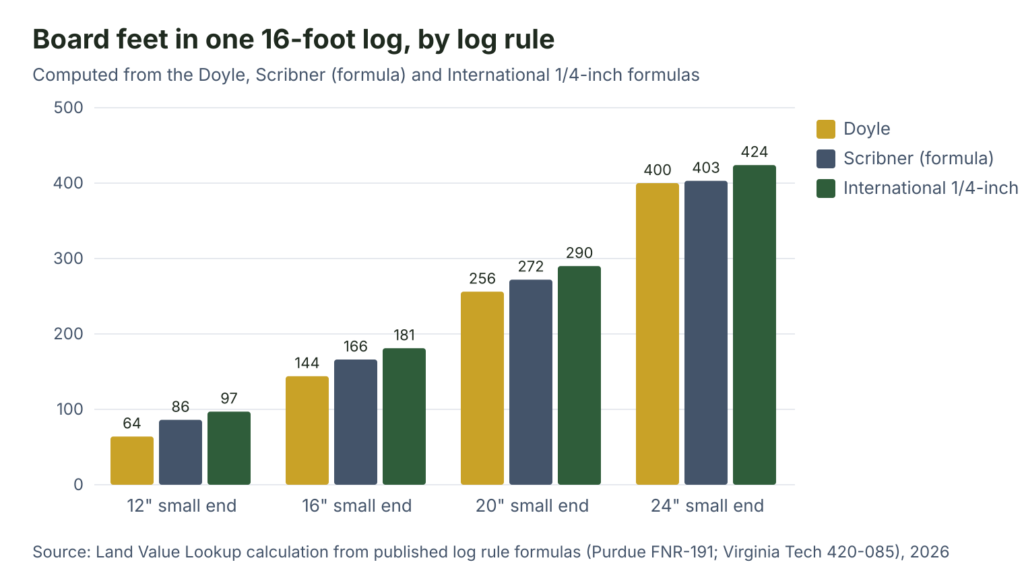
Quick log rule chart (16-foot logs)
All figures are board feet for one 16-foot log, by small-end diameter inside the bark. They come from the formulas below, which are the same ones the calculator uses.
| Small-end diameter | Doyle | Scribner (formula) | International 1/4-inch |
|---|---|---|---|
| 12 inches | 64 | 86 | 97 |
| 16 inches | 144 | 166 | 181 |
| 20 inches | 256 | 272 | 290 |
| 24 inches | 400 | 403 | 425 |
Two patterns stand out. Doyle reads lowest, and the gap is biggest on small logs: at 12 inches, Doyle gives 64 board feet against 97 for International, about a third less. As logs get larger the rules converge; at 24 inches they are within about 6% of each other.

What is a board foot?
A board foot is a piece of wood 12 inches by 12 inches by 1 inch thick, or 144 cubic inches. Lumber is easy to measure in board feet. A round, tapered log is not, because some of it becomes sawdust (the saw kerf), slabs and edgings. Each log rule makes its own assumptions about that waste, which is why they disagree.
For sawn lumber, no log rule is needed: board feet = thickness (inches) x width (inches) x length (feet) / 12. A 2 x 4 that is 8 feet long is 2 x 4 x 8 / 12 = 5.33 board feet (using nominal size, as lumber is usually sold).

The three log rules
Doyle
Formula: board feet = (D – 4)² x L / 16, where D is the small-end diameter in inches inside the bark and L is the length in feet.
Doyle subtracts 4 inches from the diameter for slabs and edgings, which is a large allowance on a small log and a small one on a big log. The result: it under-counts the lumber in small logs and comes closer on large ones. Doyle is easy to compute in your head. Purdue Extension calls it the most widely used rule, especially on private timber in the East and South, and Virginia Tech notes it is widely used throughout the southern United States (Purdue FNR-191; Virginia Tech 420-085). Because it under-counts small logs, a buyer quoting a Doyle price on small timber is getting more wood than the number suggests.
Example, 16-inch by 16-foot log: (16 – 4)² x 16 / 16 = 144 board feet.
Scribner
Formula used here: board feet = (0.79 D² – 2D – 4) x L / 16.
Scribner began as a diagram rule: it drew 1-inch boards inside a circle and counted them. The common printed version is the Scribner Decimal C table, which rounds to tens of board feet. Our calculator uses the standard formula, which reads a little below the printed Decimal C table. Purdue notes Scribner was widely used by the Forest Service in the Lake States and the western United States, where it has since been largely replaced by cubic measurement. In the South, NC State’s price report uses Scribner to convert pine sawtimber between tons and board feet.
Example, 16-inch by 16-foot log: (0.79 x 256 – 32 – 4) x 16 / 16 = about 166 board feet.
International 1/4-inch
Formula: for each 4-foot section, board feet = 0.905 x (0.22 D² – 0.71 D), with the diameter increased by half an inch for each section to allow for taper. The sections are added together.
International 1/4-inch assumes a 1/4-inch saw kerf, allows for shrinkage and accounts for taper, so it is the closest of the three to what a modern mill actually saws. It is often used for forest inventory work, and Penn State’s timber market report quotes its prices in International 1/4-inch.
Example, 16-inch by 16-foot log: four sections at 16, 16.5, 17 and 17.5 inches, totaling about 181 board feet.
How to measure a log
- Measure the small end. All three rules use the diameter at the smaller end, inside the bark. Measure across the narrowest width, or average two measurements at right angles, and round down to the nearest inch.
- Measure the length. Logs are usually bucked in 2-foot increments (8, 10, 12, 14, 16 feet) plus a few inches of trim allowance. Don’t count the trim.
- Pick the rule your buyer or contract uses.
- Deduct for defects. Rot, sweep, crook and seams reduce usable volume. Scalers make deductions; the formulas don’t.
For standing trees, foresters estimate the number of 16-foot logs in each tree and the diameter at the top of each log. That is how a cruise turns into a total volume for a stand.
Why the rule matters to your timber check
Suppose a buyer offers a price per thousand board feet (MBF). If the volume is counted in Doyle and you were thinking in International 1/4-inch, you could be comparing numbers that are a third apart on small logs. Penn State Extension publishes factors for converting prices between rules: a Doyle price is about 1.695 times an International 1/4-inch price, and a Scribner price is about 1.159 times (Penn State Extension, Pennsylvania Timber Market Report, Second Quarter 2026). In that report, northern red oak in Northwest Pennsylvania averaged $532 per MBF International 1/4-inch for April to June 2026, which converts to about $902 per MBF Doyle for the same wood.
The practical rule: always ask which log rule a bid uses, and compare bids in the same rule.
Running the numbers
The board foot calculator takes the log rule, small-end diameter, log length and number of logs, and returns total board feet and board feet per log. Add a price per thousand board feet and it shows the value at your price. Once you have volumes for each product, the timber sale value calculator combines sawtimber and pulpwood lines and subtracts a forester’s fee.
A quick example: 20 logs, each 16 inches by 16 feet. – Doyle: 20 x 144 = 2,880 board feet – Scribner (formula): 20 x 166 = about 3,320 board feet – International 1/4-inch: 20 x 181 = about 3,610 board feet
At a hypothetical $500 per MBF, that is $1,440 under Doyle and about $1,806 under International. That gap is the reason to agree on the rule before you agree on the price.
Hardwood states and land values
Board-foot pricing matters most in hardwood country. For context, USDA NASS put 2026 farm real estate (land and buildings) at $8,700 per acre in Pennsylvania, $9,650 in Ohio and $6,700 in Wisconsin. Those are statewide farmland survey averages, not appraisals and not timberland prices, but each state page has a 2010-to-2026 table if you want to see the trend. See all states at land values by state.
FAQ
Which log rule is most accurate? International 1/4-inch is generally the closest to actual mill output because it accounts for kerf and taper. Doyle under-counts small logs.
Why do buyers use Doyle? Custom and simplicity. It is long established in many hardwood markets. It is not wrong, but you must compare prices in the same rule.
Does the calculator match printed Scribner tables? Close, not exact. It uses the Scribner formula, which reads slightly below the printed Scribner Decimal C table.
How many board feet are in a 2×4? Board feet = thickness x width x length in feet / 12. An 8-foot 2×4 is 5.33 board feet; a 10-foot 2×4 is 6.67 board feet.
Do I measure the big end or the small end of a log? The small end, inside the bark. All three log rules are built on small-end diameter.
General information only. For a timber sale, have a forester cruise and scale your timber.


