Last updated: November 21, 2026
Stumpage prices are what a buyer pays for standing trees, before anyone cuts or hauls them. If you own woodland and are thinking about a harvest, stumpage is the number that matters to you, because logging and trucking costs come out of the mill’s delivered price before you see a dollar. This guide explains how stumpage is quoted, why sawtimber and pulpwood are priced so differently, and what state reports showed in 2025 and 2026.
2026 stumpage prices at a glance
Southern pine is mostly sold by the ton. Here are statewide averages from three published reports:
| Product ($ per ton) | North Carolina, Q3 2026 | Mississippi, Q2 2026 | Texas, Nov/Dec 2025 |
|---|---|---|---|
| Pine sawtimber | $28.61 | $22.03 | $28.63 |
| Pine chip-n-saw | $19.73 | $12.52 | $14.66 |
| Pine pulpwood | $7.36 | $4.77 | $6.01 |
| Oak sawtimber | $45.74 | $57.35 | n/a |
| Mixed hardwood sawtimber | $28.10 | $39.81 | $37.87 |
| Hardwood pulpwood | $4.56 | $9.02 | $6.93 |
Sources: NC State Extension, North Carolina Standing Timber Price Report 2026 and Mississippi State University Extension, Mississippi Timber Price Report, 2nd Quarter 2026 (both use Timber Mart-South data); Texas A&M Forest Service, Texas Timber Price Trends, November/December 2025. The NC State page heads its third-quarter table “2nd Quarter 2026”, apparently a carried-over label; the figures used here are the ones under its “3rd Quarter 2026” heading, which differ from the Q2 table.
Hardwood sawtimber in the Northeast and Appalachia is usually sold per thousand board feet (MBF). Penn State Extension’s Pennsylvania Timber Market Report for April to June 2026 gave these average prices, in dollars per MBF, International 1/4-inch rule:
| Species | Northeast PA | Southeast PA | Northwest PA | Southwest PA |
|---|---|---|---|---|
| Northern red oak | $472 | $587 | $532 | $554 |
| White oak | $490 | $698 | $580 | $662 |
| Black cherry | $618 | no data | $486 | $155* |
| Hard maple | $402 | no data | $433 | $313 |
| Yellow-poplar | $300 | $384 | $211 | $274 |
Source: Penn State Extension, Pennsylvania Timber Market Report, Second Quarter 2026. *Based on a single report. Penn State also publishes the range of one standard deviation around each average; for northern red oak in Northeast PA it ran from $201 to $744 per MBF, which shows how wide real sale prices spread.

What “stumpage” means, and how it differs from delivered prices
A mill pays a delivered price for logs at its gate. The logger who cuts and hauls the wood covers labor, fuel, equipment and trucking out of that. What is left for the landowner is the stumpage price. Because harvesting costs are similar whether the wood is valuable or not, low-value products like pulpwood leave very little stumpage, and long hauls to a distant mill can push stumpage down further.
That is also why stumpage is local. A tract near several competing mills, with good road access and a large harvest volume, usually brings more than a small, hard-to-reach tract in the same county.
Sawtimber, chip-n-saw and pulpwood
- Sawtimber is the largest, best-formed material, sawn into lumber, timbers or veneer. It carries the highest price.
- Chip-n-saw (Southern pine) is mid-size wood. Mills saw some lumber from it and chip the rest.
- Pulpwood is small-diameter or low-quality wood, used for paper, packaging, pellets and other fiber.
In North Carolina in Q3 2026, pine sawtimber brought $28.61 a ton against $7.36 for pine pulpwood. In Mississippi in Q2 2026, oak sawtimber brought $57.35 a ton against $9.02 for hardwood pulpwood. Growing trees from the pulpwood class into the sawtimber class is how a stand gains most of its value.
Per ton vs per board foot: converting between units
Prices quoted in different units can’t be compared directly. Two sets of published factors help:
Weight to volume (NC State Extension): – Pine sawtimber: about 7.0 tons per 1,000 board feet (Scribner) – Chip-n-saw: about 8.0 tons per 1,000 board feet (Scribner) – Pulpwood: about 2.68 tons per standard cord – Hardwood sawtimber: about 9.0 tons per 1,000 board feet (Doyle)
So North Carolina’s Q3 2026 pine sawtimber average of $28.61 a ton works out to roughly $200 per MBF Scribner ($28.61 x 7.0). Texas publishes both units: its statewide pine sawtimber average of $28.63 a ton was listed as $229.04 per MBF for November/December 2025, using its own conversion.
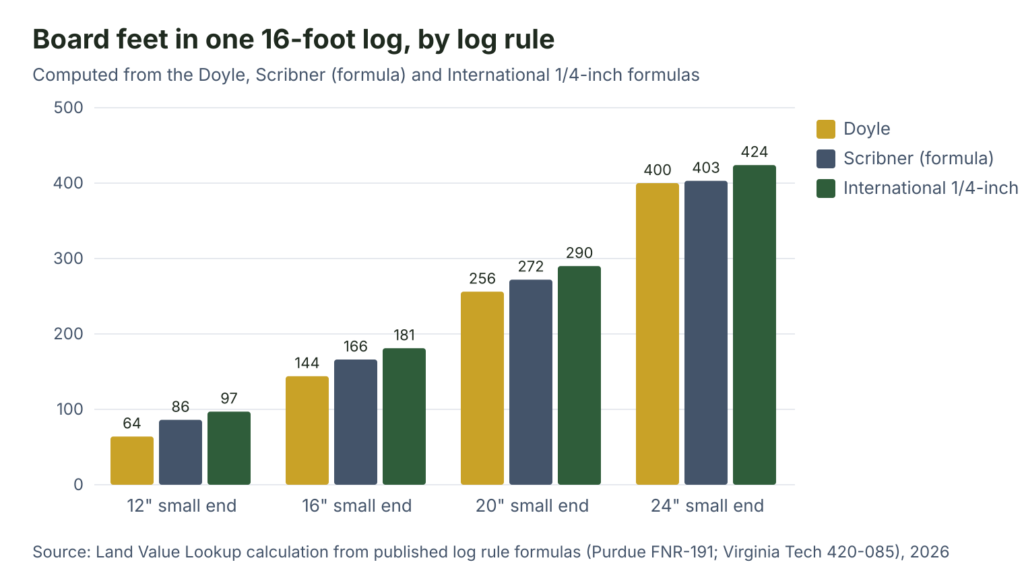
Log rule to log rule (Penn State Extension): – Doyle price = 1.695 x International 1/4-inch price – Scribner price = 1.159 x International 1/4-inch price
A Doyle price looks higher because the Doyle rule counts fewer board feet in the same log, so each counted board foot costs more. A northern red oak price of $472 per MBF International (Northeast PA, Q2 2026) is roughly $800 per MBF Doyle. To see how the rules differ for your logs, use the board foot calculator.
How prices move
Stumpage changes quarter to quarter. North Carolina pine pulpwood was $8.33 a ton in Q1 2026, $7.02 in Q2 and $7.36 in Q3. Mississippi pine sawtimber fell 8.28% from Q1 to Q2 2026, to $22.03, while oak sawtimber rose 15.32% to $57.35. Texas pine sawtimber was up 2% from a year earlier in its November/December 2025 report.  North Carolina pine stumpage, Q1 to Q3 2026. Each product moves on its own.
Housing starts, mill openings and closures, weather that limits logging, and export demand all play a part, and none of them is something a landowner controls. A harvest that isn’t urgent can often wait for a better market, since trees keep growing.
Southern and Appalachian land context
Stumpage is about trees; USDA land values are about land and buildings on farms. USDA NASS does not publish timberland values, but its 2026 farm real estate averages give a sense of land prices in the main timber states. Each state page has a year-by-year table:
| State | Farm real estate, 2026 ($/acre) | Pasture, 2026 ($/acre) |
|---|---|---|
| Georgia | $4,950 | $5,100 |
| Alabama | $4,250 | $3,500 |
| South Carolina | $4,900 | $4,500 |
| North Carolina | $5,750 | $6,380 |
| Virginia | $6,300 | $5,430 |
| Kentucky | $5,600 | $4,050 |
| Tennessee | $6,500 | $5,910 |
| West Virginia | $3,640 | $2,400 |
Source: USDA NASS, Land Values 2026 Summary. These are statewide survey averages for farmland, not appraisals and not timberland prices.
Where to find stumpage prices for your state
- North Carolina: NC State Extension standing timber price report, quarterly.
- Mississippi: MSU Extension timber prices, quarterly.
- Texas: Texas A&M Forest Service Timber Price Trends, bimonthly, with regional prices.
- Pennsylvania: Penn State Extension timber market report, quarterly, per MBF by species and region.
- Other states: many state forestry agencies and extension services publish their own; ask your state forester. Southern reports often license data from Timber Mart-South.
Turning stumpage prices into a sale estimate
- Get a cruise from a forester that breaks volume into products.
- Find a current local price for each product, in the same unit as the cruise.
- Multiply and add, then subtract any forester’s fee.
The timber sale value calculator does step 3 for you. Enter tons or MBF for each product and the price per unit, and it shows gross value, the fee and your net.
FAQ
What is a good pine stumpage price per ton? “Good” depends on product and place. Statewide pine sawtimber averages in the reports above ranged from $22.03 (Mississippi, Q2 2026) to $28.63 (Texas, Nov/Dec 2025). Your price depends on log quality, volume, access and nearby mills.
Why is my hardwood priced per board foot and my pine per ton? It is regional custom. Southern pine markets mostly trade by weight; many hardwood sawlog markets trade by scaled board feet. Use published conversion factors to compare.
Do these prices include logging? No. Stumpage is the price for standing timber. Logging and hauling are the buyer’s costs.
How often are stumpage prices updated? Most state reports are quarterly; Texas publishes every two months. Prices can move several percent between reports, so use the latest one and confirm with local bids.
General information only, not an appraisal or financial advice. Prices vary by region and quarter; get bids on your own timber.