
Last updated: November 21, 2026
A land loan calculator is only as good as the numbers you put in it: the price, the down payment, the rate and the term. This guide gathers the 2026 figures you can actually check (USDA Farm Service Agency rates, Federal Reserve lender surveys, and USDA average land prices) and shows worked monthly payments, so you go into a lender meeting knowing roughly what to expect. It is general information, not a loan offer or financial advice; your rate depends on your credit, the property and the lender.
2026 rates at a glance
| Source | Loan type | Rate |
|---|---|---|
| USDA Farm Service Agency, effective Nov. 1, 2026 | Farm Ownership, Direct | 6.250% |
| USDA Farm Service Agency, effective Nov. 1, 2026 | Farm Ownership, Down Payment | 2.250% |
| USDA Farm Service Agency, effective Nov. 1, 2026 | Farm Ownership, Direct, Joint Financing | 4.250% |
| Federal Reserve, Chicago district, Q1 2026 | Average fixed farm real estate loan | 6.7% |
| Federal Reserve, St. Louis district, Q1 2026 | Average fixed farm real estate loan | 7.1% |
Sources: USDA FSA, Current FSA Loan Interest Rates; farmdoc daily, “Agricultural Credit Conditions in Illinois, First Quarter 2026” (June 2026), summarizing the Chicago and St. Louis Federal Reserve district surveys.
The Federal Reserve figures are averages that agricultural bankers reported; they describe the market, not what any one borrower will get. farmdoc daily noted that real estate loan rates had come down from their 2023 peaks and were lower than a year earlier, but remained historically elevated. In the St. Louis district, the average fixed rate was 7.1% in Q1 2026, down from 7.6% a year earlier.
FSA loans are for eligible farmers and ranchers, and FSA sets its rates monthly, so check the current page before you plan around them.
Down payments: what lenders tend to ask
Land is usually financed differently from a house. Our land loan calculator notes that land loans often need a larger down payment and carry a higher rate than home loans. Raw land with no buildings or income, in particular, is seen as riskier collateral.
USDA’s FSA programs are the published exception for qualifying farm buyers. According to FSA’s Farm Ownership Loans page:
- The Down Payment Program helps beginning farmers and ranchers and requires only a 5% down payment, with FSA financing up to 45% of the purchase price or appraised value.
- Direct farm ownership loans go up to $600,000; guaranteed loans (made by commercial lenders, backed by FSA) go up to $2,558,000.
- Repayment terms run up to 40 years for real estate.
Commercial lenders, including Farm Credit associations and banks, set their own down payment and term requirements. Ask each lender for their terms in writing.
What land costs in 2026 (USDA averages)
To estimate a payment you need a price. USDA’s National Agricultural Statistics Service put U.S. farm real estate (land and buildings) at $4,500 per acre in 2026, up 3.4% from 2025, with cropland at $6,020 and pasture at $2,000 (USDA NASS, Land Values 2026 Summary, released July 31, 2026). State averages vary widely:
| State | Farm real estate, 2026 | Cropland, 2026 | Pasture, 2026 |
|---|---|---|---|
| North Carolina | $5,750 | $5,580 | $6,380 |
| Iowa | $10,100 | $10,700 | $3,800 |
| Texas | $3,100 | $2,790 | $2,420 |
| Tennessee | $6,500 | $6,400 | $5,910 |
| Kansas | $3,200 | $3,540 | $2,400 |
Dollars per acre. These are statewide survey averages, not appraisals. A particular parcel can be worth far more or less depending on location, soil, timber, water, access and improvements. Browse every state on land values by state, or multiply acres by a state average with the land value calculator.
Worked examples
All payments below are principal and interest on a fixed-rate, fully amortizing loan, computed the same way the land loan calculator does. They leave out taxes, insurance and fees.
The formula is the standard one: payment = P x r / (1 – (1 + r)^-n), where P is the amount borrowed, r is the annual rate divided by 12, and n is the number of monthly payments.
Example 1: 20 acres in North Carolina
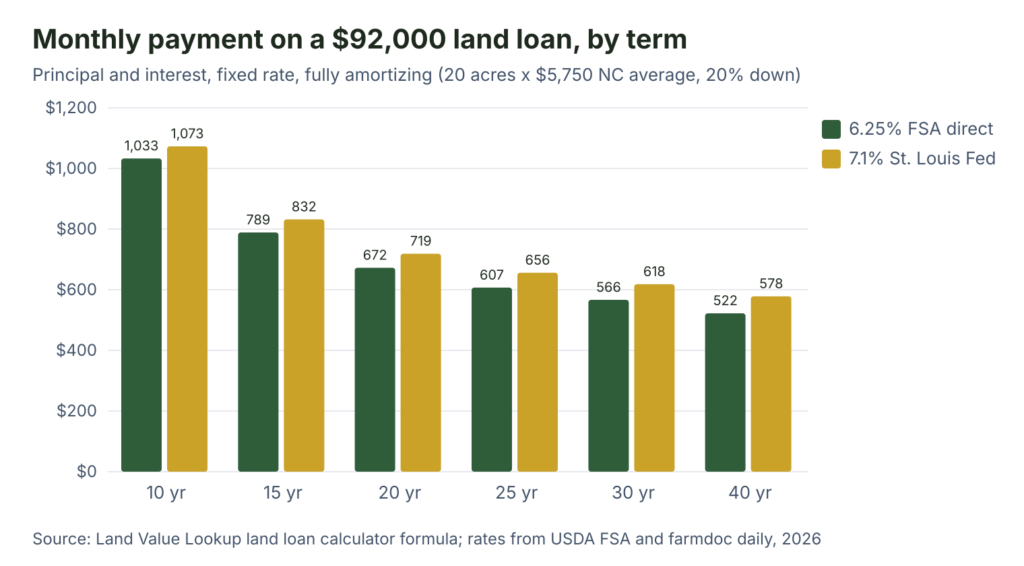
- Price: 20 acres x $5,750 (2026 NC farm real estate average) = $115,000
- Down payment: 20% = $23,000; borrowed $92,000
| Rate and term | Monthly payment | Total interest |
|---|---|---|
| 7.1%, 20 years | about $719 | about $80,500 |
| 6.25%, 30 years | about $566 | about $111,900 |
The 7.1% line uses the St. Louis district average fixed real estate rate for Q1 2026; the 6.25% line uses FSA’s direct farm ownership rate for November 2026. A longer term lowers the payment but adds about $31,000 of interest.

Example 2: 40 acres of Iowa cropland
- Price: 40 acres x $10,700 (2026 Iowa cropland average) = $428,000
| Down payment | Rate and term | Borrowed | Monthly payment |
|---|---|---|---|
| 20% ($85,600) | 6.7%, 25 years | $342,400 | about $2,355 |
| 5% ($21,400) | 6.25%, 40 years | $406,600 | about $2,308 |
The second line shows why the size of the down payment matters: putting 5% down over 40 years gives a similar monthly payment but a total interest bill of about $701,000, nearly twice the $364,000 in the first line.

Does the land pay for itself?
For farmland you plan to rent out, compare the yearly payment to the rent. Iowa cropland rented for an average of $271 per acre in 2026, according to USDA NASS cash rent data on our Iowa cash rent page. On 40 acres that is about $10,840 a year in gross rent, against roughly $28,260 a year in payments in Example 2 (line one). Rent alone usually doesn’t cover a mortgage on high-priced farmland, which is worth knowing before you buy. The lease income calculator shows net rent and the return on land value.
Questions to ask a lender
- Is the rate fixed or variable, and for how long?
- What down payment do you require for this type of land (raw, cropland, with a house)?
- What is the longest term you offer, and is there a balloon payment?
- Are there prepayment penalties?
- Do you require an appraisal or survey, and who pays?
- Am I eligible for FSA programs, or a guaranteed loan through your bank?
FAQ
What is a typical down payment for land? It varies by lender and land type. FSA’s Down Payment Program for beginning farmers requires 5%; commercial lenders commonly ask for more, especially on raw land. Get quotes.
Are land loan rates higher than mortgage rates? Often, because land is harder to resell and produces no housing collateral. Our calculator’s note says as much; compare actual quotes.
What rate should I put in the calculator? Start with a lender quote. Without one, the Federal Reserve district averages above (6.7% to 7.1% in Q1 2026) are a reasonable range to test.
How is a land loan payment calculated? With the standard amortization formula: payment = P x r / (1 – (1 + r)^-n), where r is the monthly rate and n the number of payments. The land loan calculator does this for you.
This is general information, not financial or lending advice. Rates change monthly; confirm with a lender.


