

Last updated: November 21, 2026. Benchmarks: USDA NASS Land Values 2026 Summary.
To calculate land value per acre, divide a property’s total value (or sale price) by its acres. To estimate what your own land is worth, reverse it: multiply your acres by a fair price per acre. The hard part is picking that price, so this guide shows how to start from a USDA benchmark, adjust for your parcel, and check the result against local sales and rent.
Quick formulas
- Value per acre = total value ÷ acres
- Estimated value = acres × price per acre
- Acres = square feet ÷ 43,560
| Example | Acres | 2026 NASS average | Rough value |
|---|---|---|---|
| Iowa cropland | 80 | $10,700/acre | $856,000 |
| North Carolina pasture | 40 | $6,380/acre | $255,200 |
| Kansas cropland | 160 | $3,540/acre | $566,400 |
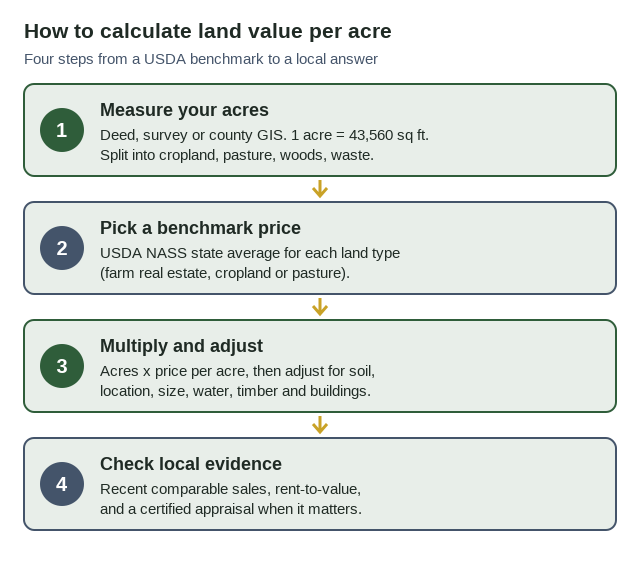
Step 1: Know exactly how many acres you have
Start with the deed, a survey plat or your county’s GIS parcel viewer. If you only have measurements, convert to acres: one acre is 43,560 square feet.
- A rectangle 660 feet by 330 feet is 217,800 square feet: 5 acres.
- A square 1,320 feet on each side (a quarter mile) is 40 acres.
The acreage calculator converts feet, yards, meters, chains or rods and gives hectares too. Also note how the acres split: tillable cropland, pasture, woods, and land lost to roads, water or wetlands. Each is worth a different amount.
Step 2: Find a benchmark price per acre
USDA’s National Agricultural Statistics Service (NASS) publishes three averages per state every year. Choose the one that matches your land:
- Farm real estate: land and buildings together, for a farm with a house or outbuildings.
- Cropland: bare land used for crops.
- Pasture: grazing land.
The land values by state table lists all three for every state with NASS estimates. In 2026 the U.S. averages were $4,500 for farm real estate, $6,020 for cropland and $2,000 for pasture, according to the NASS Land Values 2026 Summary.
| State | Farm real estate | Cropland | Pasture |
|---|---|---|---|
| Iowa | $10,100 | $10,700 | $3,800 |
| North Carolina | $5,750 | $5,580 | $6,380 |
| Kansas | $3,200 | $3,540 | $2,400 |
Source: USDA NASS, 2026.
Mixed land: value each part and add. A 100-acre Iowa farm with 70 acres of cropland and 30 of pasture: 70 × $10,700 = $749,000, plus 30 × $3,800 = $114,000, for $863,000 before buildings, or $8,630 an acre.
The land value calculator fills in the 2026 NASS average when you choose a state and land type, and accepts your own per-acre figure.
Step 3: Adjust for what makes your parcel different
A state average folds all the land in a state into one number. Ask how yours compares:
- Soil and productivity. Better soils earn and sell for more. Some states publish ratings, such as Iowa’s CSR2 (5 to 100) or Illinois’s soil productivity index.
- Location. Distance to town, road frontage and development pressure can push prices far above farm value.
- Size and shape. Small tracts usually sell for more per acre; odd shapes and poor access for less.
- Water. Irrigation, wells, ponds and water rights add value, especially in the West. In Texas, irrigated cropland averaged $3,500 an acre in 2026 against $2,700 for dryland.
- Timber. Merchantable timber is a separate asset. The timber value calculator helps once a forester gives you volumes.
- Buildings and improvements. Houses, barns, fences, tile drainage and grain bins.
- Limits. Floodplain, wetlands, easements and zoning reduce what can be done with the land.
There’s no fixed formula for these adjustments, which is why Step 4 matters.
Step 4: Check against local evidence
Comparable sales (the main method)
Appraisers rely most on the sales comparison approach. Find recent sales of similar land nearby, ideally within a year or two, and compare price per acre after allowing for differences. County register of deeds and assessor records, farm real estate brokers and some land-grant universities publish sales data.
Income: rent as a share of value
If your land is farmed, its rent shows what it earns. In 2026, Iowa cropland rented for $271 an acre against a $10,700 value, about 2.5%. Kansas cropland rented for $77.50 against $3,540, about 2.2%. Our cash rent by county pages show local rents.

Appraisers use a version of this called the income approach: net rent divided by a capitalization rate drawn from local sales. For example, $250 of net rent at a 2.5% cap rate implies $10,000 an acre. Small changes in the rate move the answer a lot, so it’s a professional judgment, not a rule of thumb.
Assessed value
County property tax assessments are a weak guide. Many states assess farmland on its use value, which can be far below market value.
A full worked example
A landowner in Kansas has a 160-acre quarter section: 120 acres of dryland cropland and 40 acres of pasture, no buildings.
- Acres. 160, confirmed from the county parcel map.
- Benchmark. 120 × $3,540 (2026 Kansas cropland) = $424,800. 40 × $2,400 (2026 Kansas pasture) = $96,000. Total $520,800, about $3,255 an acre.
- Adjust. It sits on a paved road near town with above-average soils, so the owner expects it to sell above the state average, but not by a known amount.
- Check. Three recent similar sales in the county, a talk with a local farm manager, and the county rent figure narrow the range.

The benchmark gives a sensible starting point. Local evidence gives the answer.
When should you get a professional appraisal?
Get a certified appraisal when real money or legal duties are involved: selling, buying, settling an estate, dividing property, borrowing, donating a conservation easement or reporting for taxes. Lenders, courts and the IRS generally expect one. An appraiser inspects the land, pulls comparable sales and writes a report you can rely on. The American Society of Farm Managers and Rural Appraisers lists accredited rural appraisers.
The limits of averages
NASS figures are annual survey averages based on what farm operators believe their land would sell for. They’re reliable for trends and comparisons and useful as a first estimate, but they’re not appraisals, price quotes or financial advice. You can pull the original series from NASS Quick Stats.
FAQ
What is the formula for land value per acre?
Value per acre = total value ÷ acres. To estimate your land’s value, multiply acres by a per-acre price from comparable sales or a benchmark such as the USDA state average.
How do I calculate price per acre from a listing?
Divide the asking or sale price by the acres. A 25-acre tract listed at $150,000 is $6,000 an acre. Compare that with similar recent sales, not just the state average.
How many square feet are in an acre?
43,560 square feet. Divide square feet by 43,560 to get acres.
How do I value land with cropland, pasture and woods?
Value each part separately at its own price per acre and add them, then adjust for buildings and location.
Is the USDA land value the same as market value?
No. It’s a statewide survey average. Market value for one parcel comes from local sales and an appraisal.


